"Camelina vs. Fallow" · Pillar: Diversify Revenue / Economics · Category: Economics / Comparison · Audience: Growers and the advisors they trust · Est. read: 6 minutes
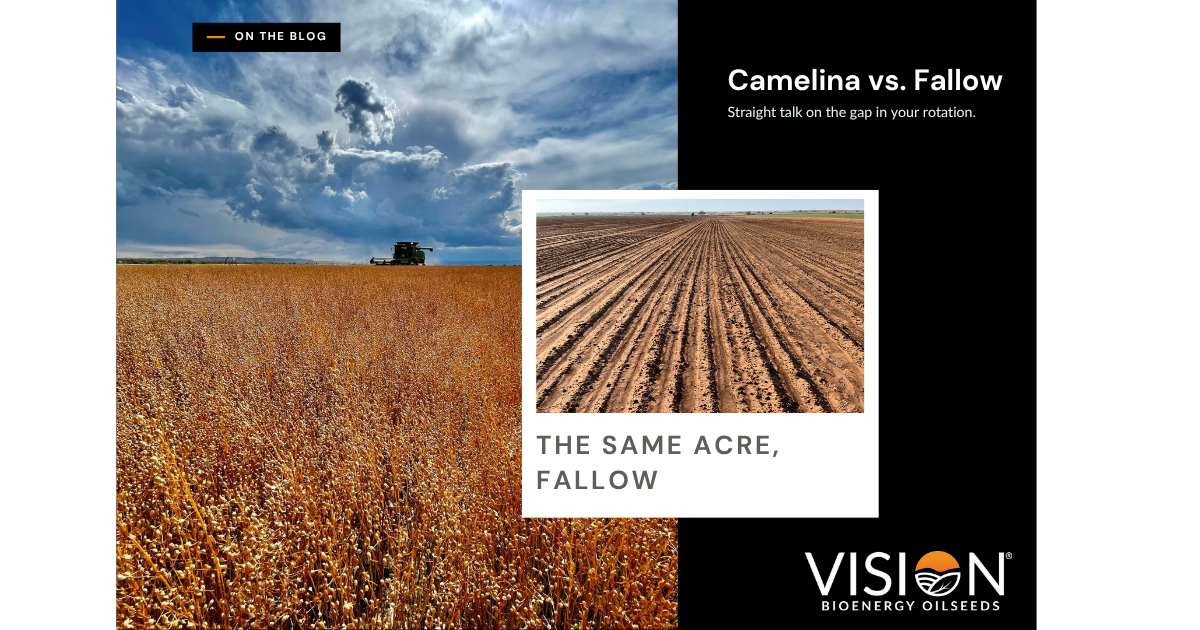
Every operation has at least one. An acre that goes fallow between rotations, or sits open after a short-season crop comes off early. It is not costing you cash today, but it is not earning anything either. That is the real camelina vs. fallow question: not whether camelina beats corn or wheat, but what a fallow acre could be doing instead if you put something on it.
This is not a pitch to rip out what already works. It is an honest look at the acre that currently does nothing, and what camelina does differently on that same ground.
What Fallow Ground Actually Costs You
Fallow feels free because no cash goes out. But research on dryland fallow systems shows the ground is not neutral while it sits there.
- No revenue. The acre produces nothing for a full season.
Less erosion protection. USDA's Natural Resources Conservation Service points to soil cover and a living root as the first defense against wind and water erosion; bare or fallow ground loses that protection (USDA NRCS, Soil Health Principles and Practices).
That is not theoretical in this region. A National Academies review of soil health research points to measured wind erosion on fallow fields in the Pacific Northwest's dryland wheat country as a documented, ongoing concern (National Academies of Sciences, Engineering, and Medicine, Exploring the Linkages Between Soil Health and Human Health, 2024).
Weed seed can build, not just volunteer growth. Research on Pacific Northwest dryland fallow found that chemical fallow, without tillage to bury weed seed, increased the weed seed bank compared with tillage-based systems (Weed Responses to Fallow Management in Pacific Northwest Dryland Cropping Systems, National Library of Medicine).
None of that shows up as a line-item expense, which is exactly why it is easy to overlook. It shows up later, in erosion and weed pressure on the acres that follow.
What Camelina Adds to That Same Acre
Camelina is built for the ground that would otherwise sit open.
- A new revenue line, without touching your primary crop acres.
- A guaranteed 100% grain offtake agreement, in writing, before you plant. No independent marketing required.
Low input and drought tolerant. Colorado State University Extension notes camelina requires little fertilization and performs well on marginal, low-rainfall ground (Guide for Producing Dryland Camelina in Eastern Colorado, CSU Extension).
A short 85 to 100 day season, the trait university extension programs across the wheat belt point to as what lets camelina intensify an existing wheat-fallow rotation instead of replacing it (Ehrensing and Guy, Oregon State University Extension; Agricultural Marketing Resource Center).
A living root and ground cover for the season, which NRCS identifies as a core practice for reducing erosion and supporting soil biology (USDA NRCS, Soil Health: Continual Live Plant/Root).
It carries many of the regenerative benefits growers look for in a cover crop. The difference is that camelina pays you back on the acre instead of costing you to establish it.
Camelina vs. Fallow, Side by Side
Fallow ground:
- No revenue for the season
- No living root, higher erosion risk
- Weed pressure carries into next season
- Eventual burndown or tillage cost with no crop to show for it
Camelina:
- Added revenue through a guaranteed offtake agreement
- Living root in place, reducing erosion risk
- Broad-spectrum, over-the-top weed control now available through JUMPSTART®, the leading commercial glufosinate-tolerant technology in camelina
- Works with the no-till to conventional equipment you already run
Where Camelina Fits Your Rotation
Camelina is a rotational intermediate oilseed crop, not a replacement for your primary crops. Colorado State University Extension notes camelina requires the same equipment as wheat and fits well into a dryland, wheat-based cropping system, including as a way to intensify a wheat-fallow rotation (CSU Extension). It slots into a short window ahead of or behind the crops you already grow.
That is the practical reason it fits fallow and rotational gaps so well. It asks for less, in time and inputs, than almost anything else you could put on that ground.
Is Your Fallow Acre a Fit for Camelina?
Not every acre needs a full answer to grow camelina. It needs one that would otherwise sit fallow or open between rotations, and a grower willing to try a crop with a market already built under it.
For the trust side of that decision, the guaranteed market and the nationwide crop insurance behind it, see our earlier post: Is Camelina a Flash in the Pan? For what it could mean on your specific acres, that conversation belongs with a VISION agronomist who can walk the ground with you.
VISION Bioenergy Oilseeds. Growing the Future of Energy®.
Sources
D.T. Ehrensing and S.O. Guy, "Camelina," Oregon State University Extension Service, EM 8953-E, January 2008.
"Camelina," Agricultural Marketing Resource Center, Iowa State University.
National Academies of Sciences, Engineering, and Medicine, "Exploring the Linkages Between Soil Health and Human Health," National Academies Press, 2024.
"Weed Responses to Fallow Management in Pacific Northwest Dryland Cropping Systems," National Library of Medicine, PMC6147650.
USDA Natural Resources Conservation Service, "Soil Health Principles and Practices," farmers.gov, and "Soil Health: Principle 4 of 4 — Continual Live Plant/Root," nrcs.usda.gov.